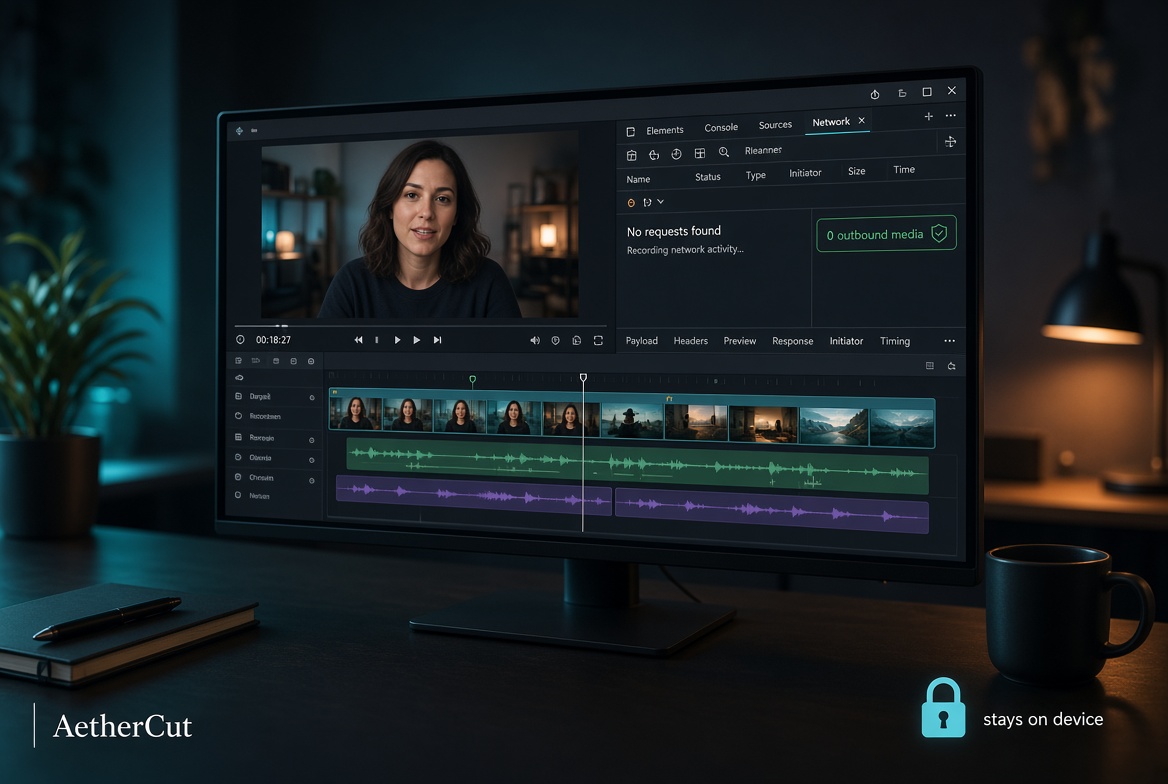
AetherCut is an in-browser NLE with a serious AI layer, a verifiable zero-upload default, a Privacy Mode that is not theater, and a free tier that does not brand your work. Try it at aethercut.app. If you care whether that privacy claim is true, do not read another paragraph. Open the Network tab and drop in a file.
AetherCut is a privacy-first, browser-based video editor that treats “your footage never leaves the device” as a claim you can check, not a slogan. It is built for people who need real NLE controls and AI assistance without sending client files, medical footage, legal discovery, or NDA work through someone else’s servers. That is the whole product thesis. Everything else — Magic Reel, Whisper captions, 4K export, Privacy Mode — is downstream of it.
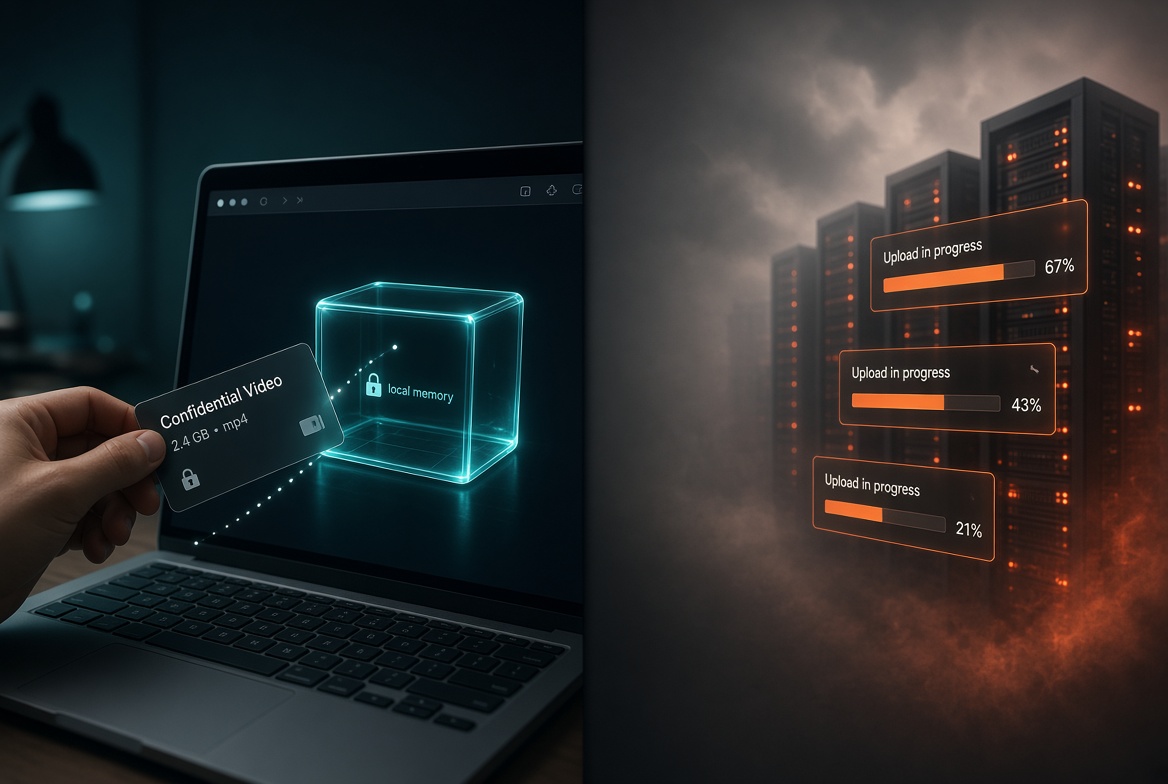
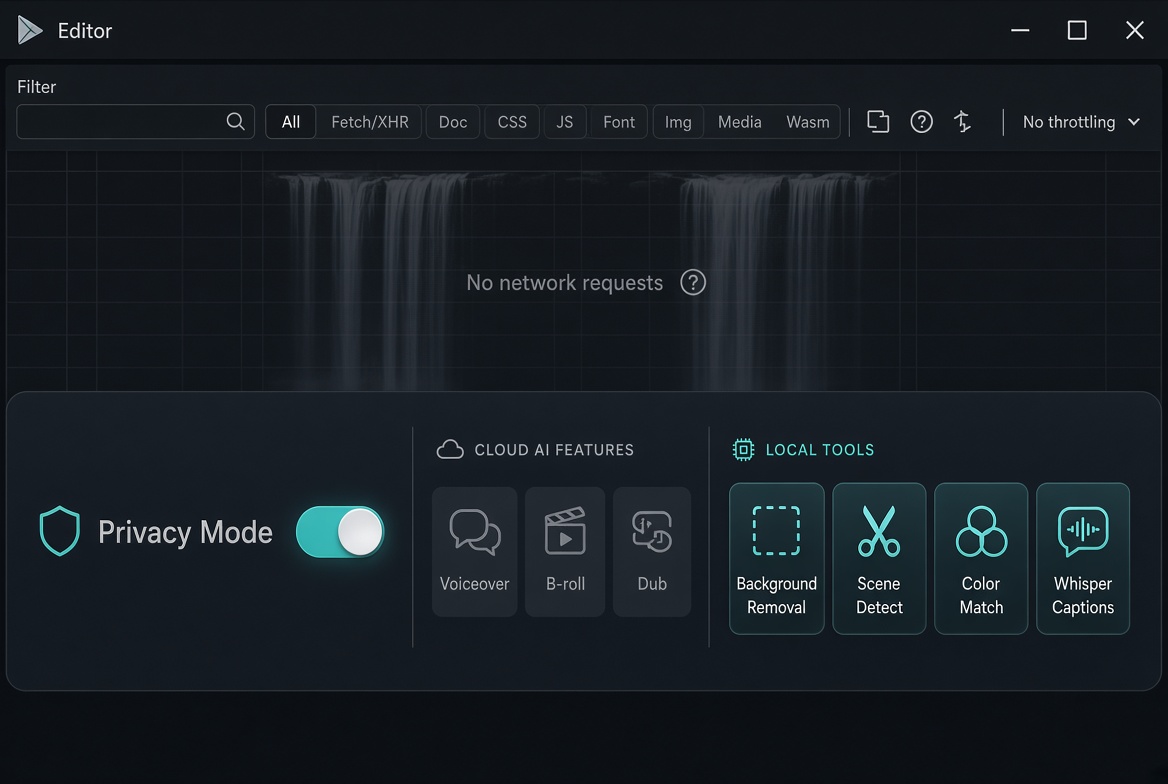
CapCut Web, Clipchamp, Descript, and most AI editors still move media off your machine. An upload bar appears. Audio goes out for transcription. A queue sits on a vendor GPU. For a TikTok, that is inconvenient. For a law firm, a hospital comms team, a journalist, or an agency under NDA, it is a compliance event. AetherCut’s answer is architectural, not policy-based. Media is read with the File API, previewed on Canvas, decoded and encoded with WebCodecs (MediaRecorder as fallback), and exported on the same hardware. Open Chrome DevTools, switch to the Network tab, drop in a clip, and you should see no outbound media. That “30-second audit” is the product’s core marketing line because it is falsifiable. Privacy Mode then kills the remaining opt-in cloud AI (voiceover, Sora-style B-roll, some caption/dub paths) in one header toggle. Local tools — background removal, scene detection, motion tracking, color match, stabilization, beat sync, and more — stay on.
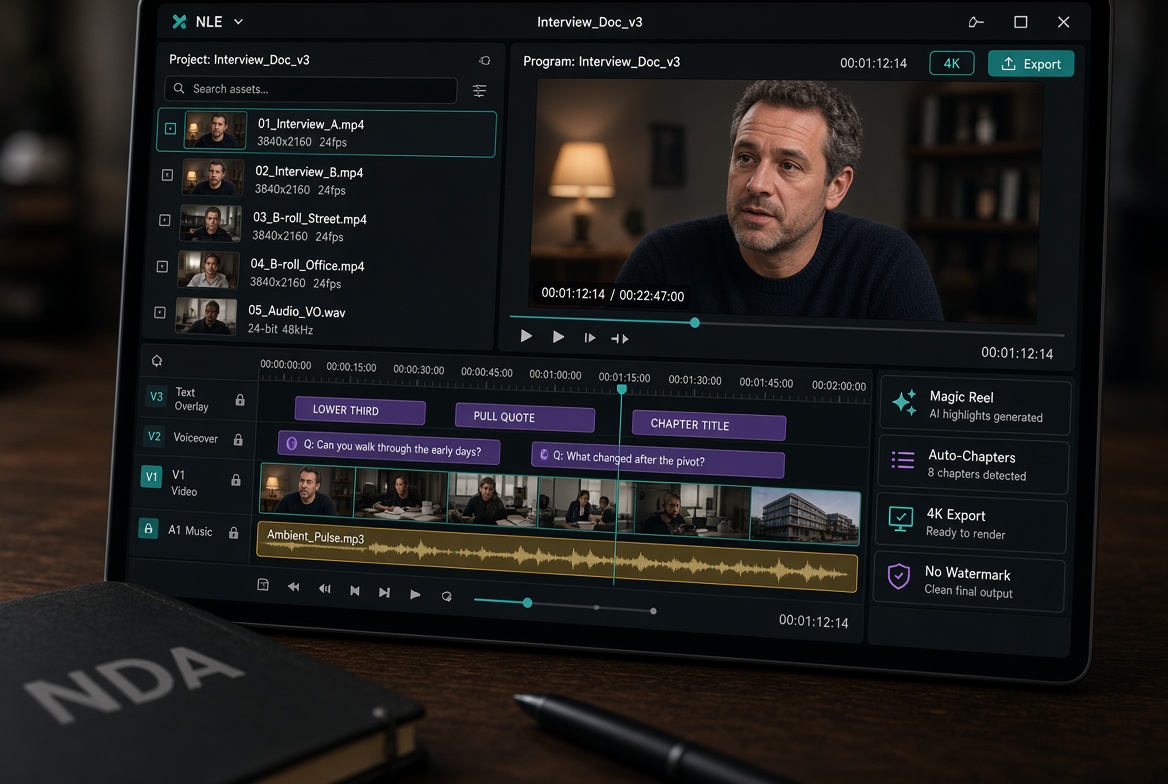
Public copy has drifted as the product shipped, but the current shape is a full multi-track timeline with frame-accurate seek, keyframes, filmstrips, detached audio rows, and standard NLE muscle — not a prompt box pretending to be an editor. Around 70–72 creative tools and ~30 AI / AI-assisted features show up in recent listings and changelogs. Standout capabilities that keep appearing in the changelog and product pages:
Magic Reel — one-click highlight pull from long-form footage On-device / local-first Whisper captions (multi-language; cloud paths are labeled and optional) AI Voice Cleanup (De-Um) and transcript-aware silence removal — cut filler and dead air from words, not from energy gates AI Director — brief in, structured shot list out (Claude/Sonnet-class planning) Eye-contact correction, object eraser, lip-sync, color match, green screen / WebGL keying Viral Kit thumbnails, Auto-Chapters for YouTube descriptions, beat-sync cuts Optional cloud AI when you choose it: ElevenLabs-style VO, Sora 2 B-roll generation 4K export, no watermark on any tier PWA / Android TWA so the same client-side editor installs like an app and can run offline with Privacy Mode on
Export is sold as hardware-accelerated and fast (marketing copy cites ~5× realtime). Collaboration is described as peer-to-peer CRDT rather than “your project lives on our box.” It is not DaVinci Resolve. It is also not another CapCut clone that happens to mention privacy in the footer.
The honest audience is narrower than “everyone who makes Reels.”
Legal, healthcare, and corporate teams who cannot sign another BAA/DPA just to cut a clip Agencies whose contracts forbid third-party processing of client media Creators who are tired of watermarks, resolution paywalls, and “free until export” traps People who want AI help and a timeline they can still touch
If your footage is public and your workflow is “prompt → wait → download,” a cloud editor may be faster. If the file is the asset and the risk, AetherCut is one of the few products that argues the data never should have left.

Most AI video tools compete on model names. AetherCut competes on jurisdiction of the pixels. That forces hard engineering: WebCodecs in production, on-device models where possible, honest labeling when a feature does need a server, and a kill switch that actually kills the network path. It also forces a different sales motion. You do not ask a CISO to trust a privacy policy. You ask them to open DevTools. The tradeoff is real. Browser memory, device GPU, and codec support still bound what “professional-level in a tab” can mean. Heavy multi-cam, huge caches, and some generative toys will always be happier in the cloud. AetherCut’s bet is that a large and underserved set of jobs never needed the cloud in the first place.